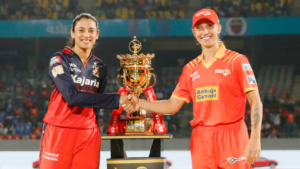
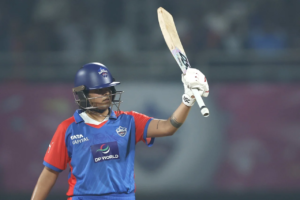
My way with words is limited, especially as compared to my ability to dissect the game. Here’s my two cents on India’s successful Women’s World Cup campaign & my experience through covering it.
It’s been a little over a week since Harmanpreet Kaur took that final catch to seal the deal. Leaping at cover, fingers pointing up, full stretch, and pouched safely. Fielders from all directions running towards Harman, screaming, celebrating, tears in their eyes.
The events that followed were a big blur. I couldn’t tell you what time it was, who hugged whom, how many iconic cricketers were on TV, what I said during a 1-hour-long livestream celebrating the win, or at what point I went to bed (6 am, I lied).
After chasing a dream for what felt like eternity, India finally became World Champions. Fifty-two years since the inception of the World Cup. Forty-nine since Shantha Rangaswamy’s girls took on the West Indies in Bangalore for India’s first international women’s game.
This wasn’t just a victory that took a couple of seasons to accomplish. This was generations of blood, sweat & tears at the very least. It was years of quashed vision, poor administration, and an eventual turnaround in a *few* aspects in recent years. You could also see that in the celebrations of the team with former players like Mithali Raj, Jhulan Goswami, and Anjum Chopra from the broadcast panel, all on the ground and in the centre of the team huddle, holding the trophy.
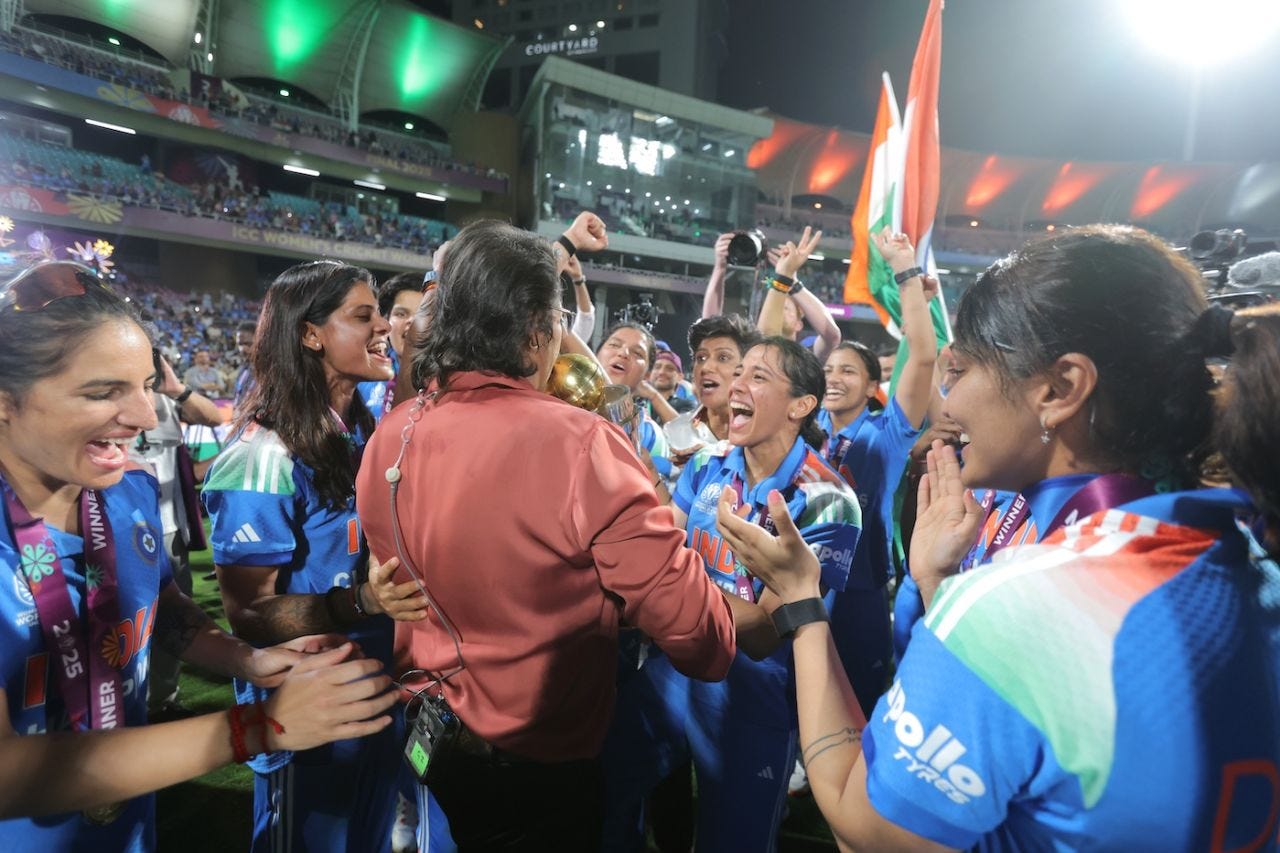
There was a collective consensus that this trophy belonged not just to the current set of players but to everyone, past or present, who had worked toward it in some capacity. It was a simple but profound gesture from the team that spoke volumes about what this victory meant.
But even out of all of these, it was the words of Diana Edulji that put into perspective the magnitude of what had been achieved that night:
“This is the proudest moment of my life. 50 years of my being on the cricket field as a player and an administrator. I am just absolutely thrilled, and I would like to congratulate the girls.”
That very Diana Edulji, who had been a part of the very first Indian international women’s fixture. That very Diana Edulji who’d captained India in their first ever World Cup in 1978. That very Diana Edulji, who’d relentlessly worked towards the betterment of women’s cricket in India. Be it through her time with the WCAI, or her attempts to persuade prominent leaders in politics and sport for their support or through her transition into the BCCI, to rebuild women’s cricket in the country from the ground up once again.
For her, this truly was it. A dream she’d seen for years and passed down to generations of girls who fought all odds, even to step out of their houses to play cricket, let alone represent the country.
It was during the 2017 World Cup that a younger Harmanpreet Kaur was in constant touch with Edulji throughout the tournament. Edulji was not impressed by Harman’s showing with the bat.
“Have you gone to England to play the stupid cricket that you’re playing?“ were her exact words to Harman, as quoted by Suprita Das’ “Free Hit“. Even after Harman’s 60 against the Kiwis, Edulji’s message read “I am still not happy with you“.
What followed had most definitely made Edulji happy, with Harman compiling one of the greatest World Cup centuries, bludgeoning her way to 171* against the mighty Australians in the semifinal of the World Cup.
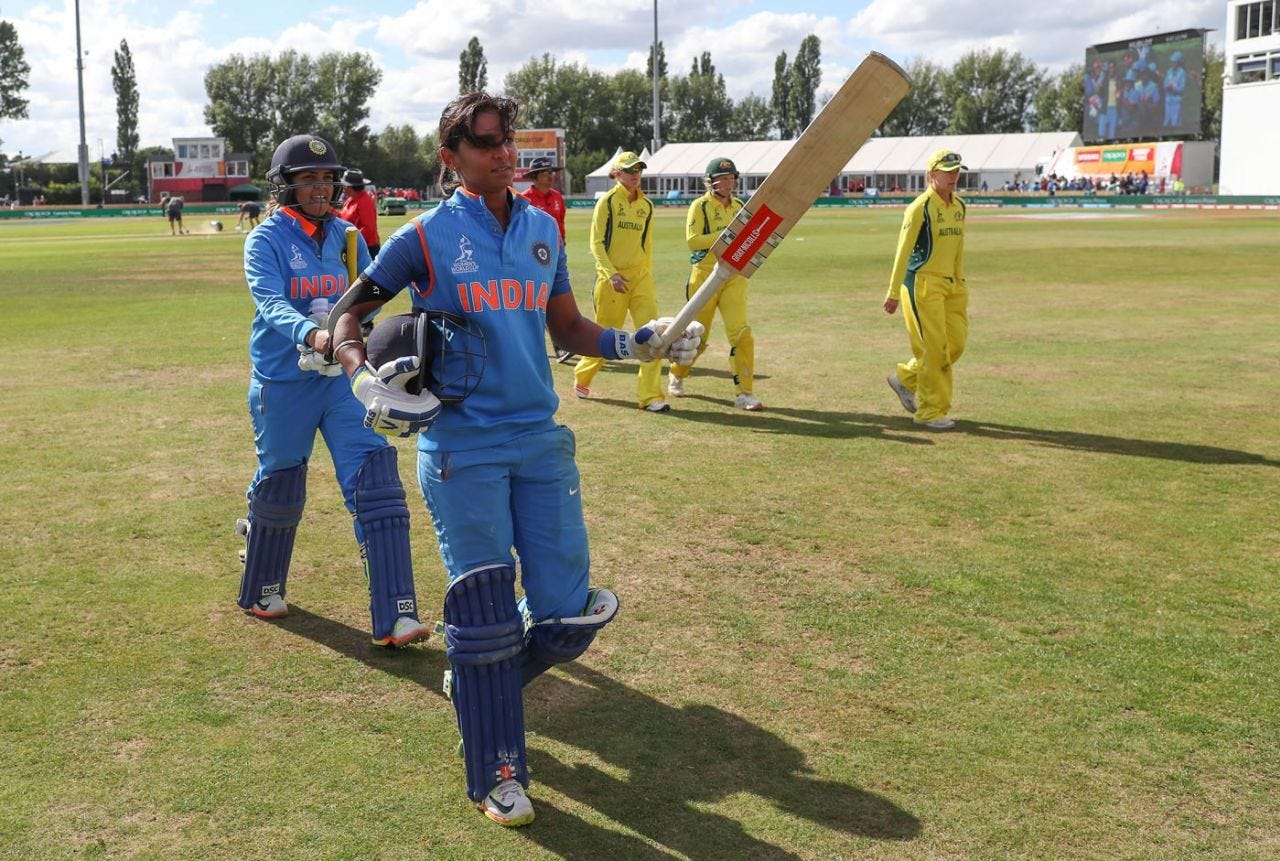
Of course, Harman shot back a message to Edulji. “Ma’am, now are you happy with me?“. Edulji’s response was ever so clear: “Now you have to bring back the Cup“. It all ended in heartbreak, with India coming agonisingly close but falling short of England’s score, losing in the final.
From there, you pan back to the start of this year. There was a certain excitement amongst the cricket fans because our girls were playing a fair amount of cricket in the lead-up to the World Cup. They were winning games convincingly, both at home & away. All this in the lead-up to a home World Cup, and it was fair to say that expectations were at a probable all-time high!
We’d had a lot of positives in how certain cogs in the team’s wheel improved, and also in the kind of selections that were being made. Sure, there were injury concerns, a large pool of players tried, and a lot of changes, but India were slowly starting to settle into a core.
Conversations in prominent women’s cricket circles were upbeat as we approached the World Cup, with victories in the Tri-nation series, the away tour of England and even a solitary win vs Australia in the ODI series, despite losing the series itself. There was a silent confidence and a genuine belief that this could be done.
For me, this was the year I fully immersed myself in women’s cricket. Of course, it was my work that compelled me to do so. Yet, it was also a curiosity that drove me to explore and cover Indian women’s cricket, so I could truly say that we covered Indian cricket in its entirety.
If it was the podcast episode with Jemimah Rodrigues that pushed me to study women’s cricket thoroughly, it was the idea that this World Cup could be history in the making that made me want to keep creating.
I’d grown up on stories of 1983 and the World Cup win. I was also lucky enough to witness 2011, the nexus event that drove me toward this incredible sport. The idea that our girls could create this moment in 2025, and the thought of being able to witness that sort of phenomenon, was a feeling you could not really picture till it happened.
The coverage of the World Cup was an incredibly rewarding journey in that I could see the gradual shift of many a viewer from being non-watchers of the women’s sport to fully being engrossed in banter around our team. Appreciation, criticism, debates—we witnessed the full monty.
And while the girls are never too far away from hate, trolls or abuse, it was the smaller, more positive things that really made the difference. The smallest changes, like a women’s cricket game being played on the TV at homes instead of a Men’s fixture and people knowing more players than just Smriti Mandhana or Harmanpreet Kaur, were big.
Stories I read on Twitter about journalists covering the sport and the constant comments or taunts they got from their own families when India lost, to the tears of sheer joy they shed when India scripted that record run chase against Australia in the semifinal.
This is what the World Cup was for me. It was story on story, from player to journalist to fan and everyone in between. The progression of the campaign and the team’s showing, riding the highs and lows, was quite the rollercoaster. There was an emotional investment in the outcome of each game, and each comment the team got, good or bad, but especially bad, almost felt personal.
This wasn’t a 100 metre sprint, but a marathon in the truest sense. A day that might have seemed a couple of seasons in the making, but was, in fact, the work of thousands of people, a ton of families, sacrifices and beliefs that challenged the status quo, willing the team forward to this metaphoric finish line.
A little under eight years to the day is what it eventually took for Harman Kaur to fulfil Diana Edulji’s wish. Whether or not the wait was worth it, only time will tell.
For now, I’m still trying to make sense of how big this victory is & what it will lead to in the short or medium term for women’s cricket. All I know is that I have my own version of 1983, where I can proudly tell the next generations about the history I witnessed being made in front of my very eyes, and that I will be tracking this team rather closely for years to come.