For a man often regarded as average with the red ball and superhuman with the pink ball, Mitch Starc, in his final few years in Test cricket, is shaping up to be his best. What’s changed?
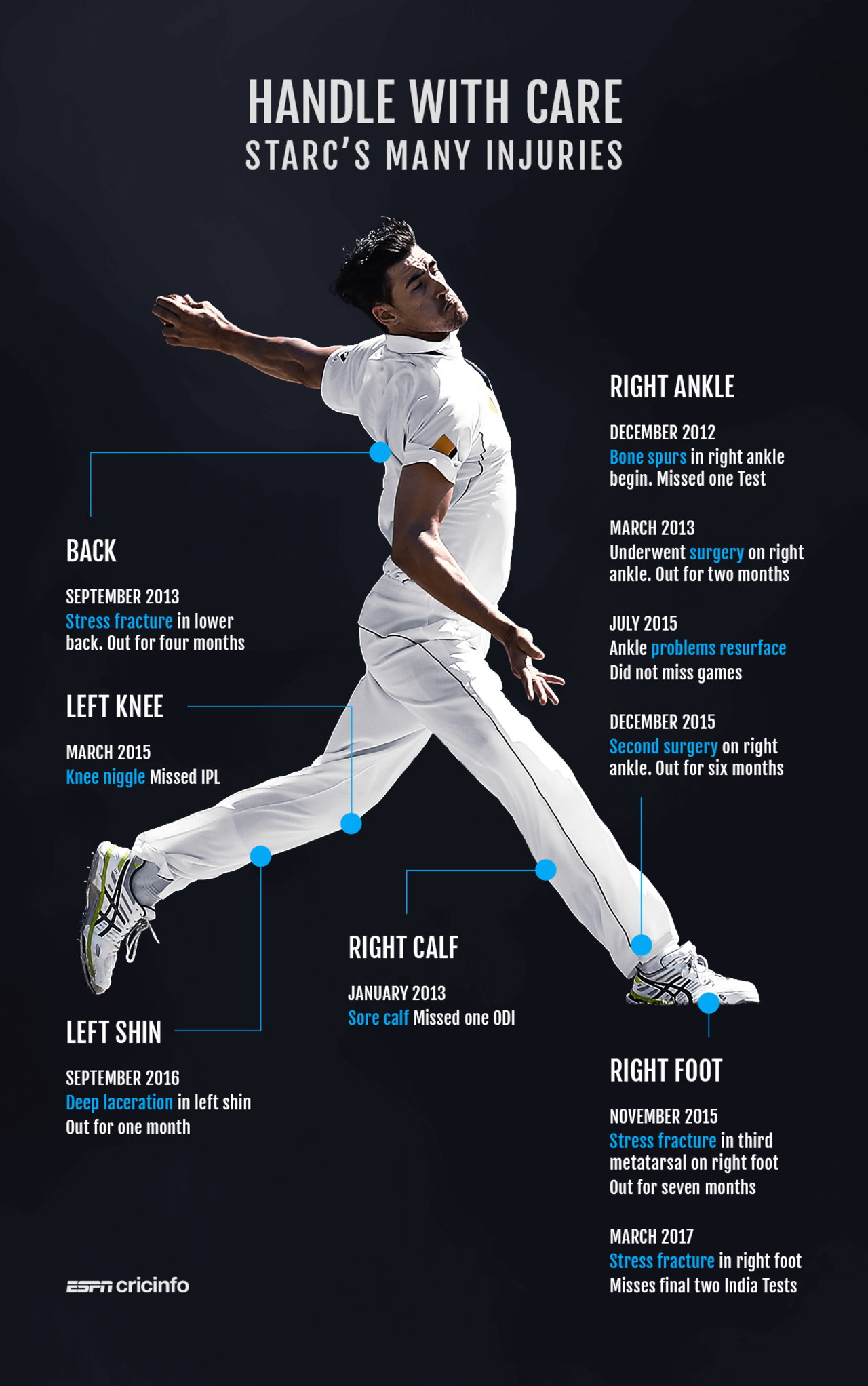
If you’d told me in 2017 that Mitch Starc would go on to play 100 Test matches for Australia, I’d confidently wager against it. Here’s a fast bowler who had so many injuries in the first few years of his Test career that ESPN had a graphic specially made by Girish T S to cover every affected body part.
And this was just the first half of his career. But he kept going. He was relentless, multi-format, quick, at you, in your face and everything that you’d want from a pacer clocking 150 on the speedgun. His approach to the crease, load up and release so smooth, it felt like a frisbee gliding through the air.
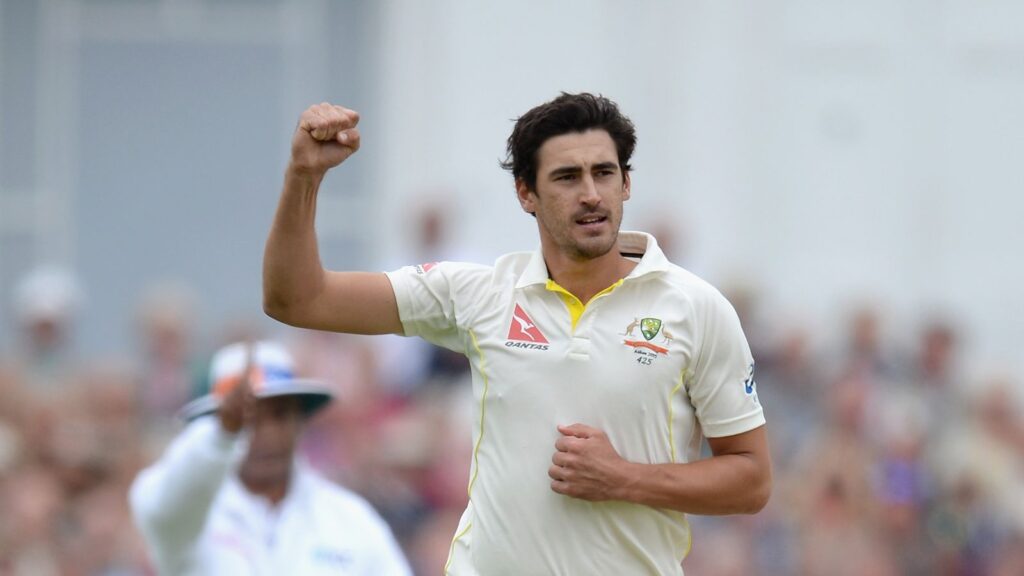
Yet with all the characteristics of being a left-armer, bowling quick, swinging and reverse swinging the ball and whatnot, Starc somehow managed to stay “average” for the first two-thirds of his Test career. It didn’t help (it actually did, read on) that he was surrounded by brilliant colleagues in Josh Hazlewood & Pat Cummins, who are often just too good.
But even by his own standards, it felt like Mitch Starc was only there and thereabouts, managing to do enough to keep his place and occasionally produce sparks of brilliance in Test cricket.
Yet, in the last couple of seasons, Starc has become a constant in Australia’s Test victories and their most present pacer. He’s played 24 Tests on the trot since 2023 and also recently went past Wasim Akram to become the highest wicket-taker for a left-arm pacer in Test cricket history.
So what’s changed? Did Starc magically become a genius overnight? Or is it a culmination of a lot of factors, all finally converging at the right moment?
We’ve done a video on this that you can check out:
Some Number Crunching
We’ll divide this into 3 phases of Starc’s Test career. Looking at 35-Test match periods and also at red and pink ball performances. I specifically look at the pink ball numbers separately, given Starc’s reputation with it and also to understand how much that’s affected his overall career.
2011 to 2017
I’ll keep the descriptions to a minimum and focus on the numbers. This was the period wherein Starc burst onto the scene as a quick left-arm pacer who constantly clocked 145-150+ kph.
He was often seen as a replacement for Mitch Johnson, and to that end, he was also picked ahead of the man in the 2013 Ashes.
This was a tricky period in that Starc was in and out due to injuries, but also because there were enough established as well as younger pacers in the circuit.
In this 35-Test period, Starc’s numbers read as follows:
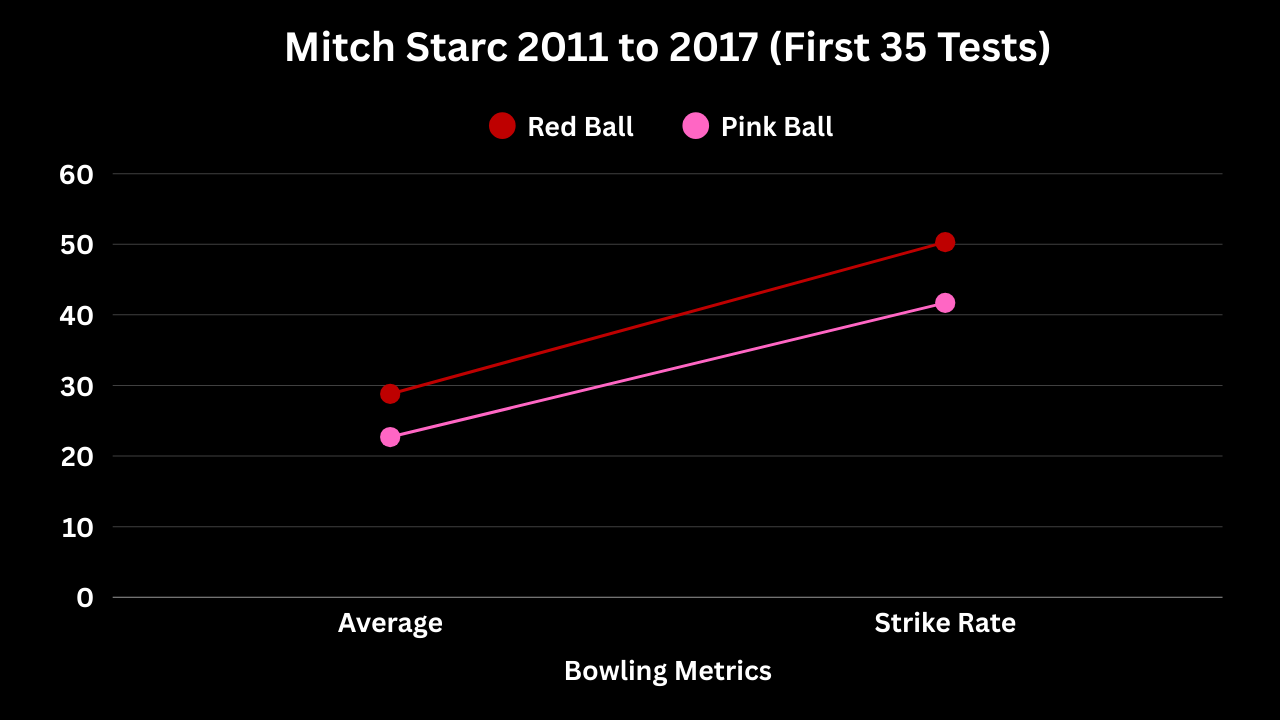
Very early and just 3 pink ball tests in, but you already start to notice Starc’s affinity toward the pink ball.
Overall, he’d picked up 145 wickets in this 35-Test period, averaging 28.1 & striking at 49.4 overall.
Thanks for reading From The Rough! Subscribe for free to receive new posts and support my work.
2017 to 2022
It was from 2015 onwards that Starc started to enjoy a consistent run in the Test format. He slowly moved towards being a senior pacer in the squad, worked on strengthening his body, & in fact was doing pretty well up until the Ashes in 2019, where he broke down after just a solitary Test match.
This is crucial because he talks about this phase in his career, where he tried to go against his instinct, both in terms of what he was trying to achieve, i.e, to stem the flow of runs as opposed to take wickets & also his action and the lengths he was trying to hit (tried bowling more good ish length balls and also tried the wobble ball at some point).
The impact was that he lost his wicket-taking ability, but along with it, he also lost his ability to bowl quickly through the air, which was such a big component of getting those big swinging yorkers in at searing pace.
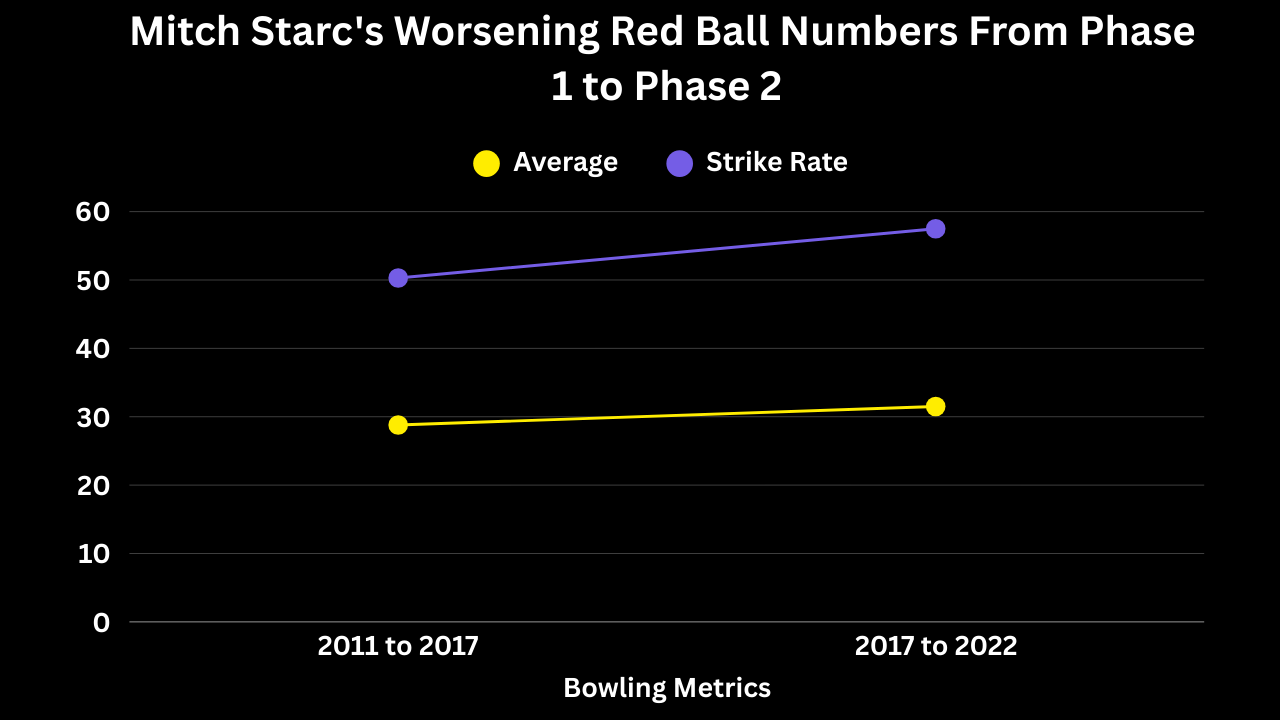
And so when you look at this phase through numbers, you notice a slight drop in red ball numbers:
Yet, when you look at his pink-ball numbers, it’s a different ball game altogether. Through this 35-Test period, Starc played 7 pink-ball games. He demolished batting lineups, picking up 40 wickets at 16.6! A wicket every 34 deliveries, and it felt like a literal cheat code when he took that glowing pink orb in his hand.
Jarrod Kimber talks about this as well, breaking down Starc the pink-ball monster. Especially the point on how his strengths, like swing and bounce through his height, are amplified with the pink ball, given its different make: lacquer, seam, the influence of conditions, etc.
But alright, his overall numbers in this 35-Test period are decent, almost identical to phase 1 in fact. 138 wickets at 27.2, striking at 50.7.
2022 to Present
This brings us to Starc of present day. The current era, where it clearly seems that Starc has taken things up a notch. It seems rather evident that Starc wants to give it his all and focus on Test cricket. By his very own admission, he skipped even a tournament like the Champions Trophy, not only to rest his ankle, but because he had his sights on the WTC Final.
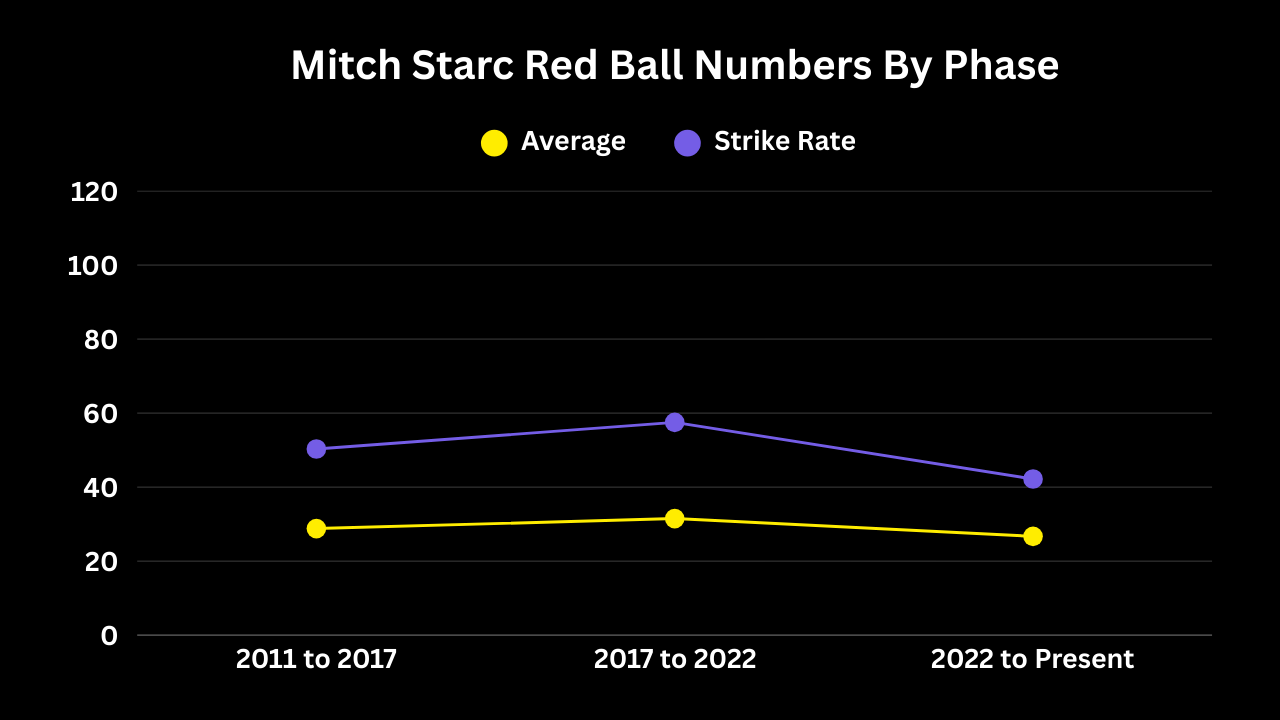
And it seems that this willingness to prioritise Tests has indeed paid off, because in the 32 Tests he’s played in this final phase of his career, he’s picked up 137 wickets at 24 apiece, striking at a brilliant 38.6.
Even his red ball numbers alone have improved significantly, as you’ll see:
What’s Changed?
So now that we’ve seen this improvement, the next natural question is what’s changed? The recent Ashes Tests make you wonder if he’s just a better bowler without Hazlewood & Cummins, so I took the liberty of running those numbers.
These are Starc’s numbers with & without the duo:
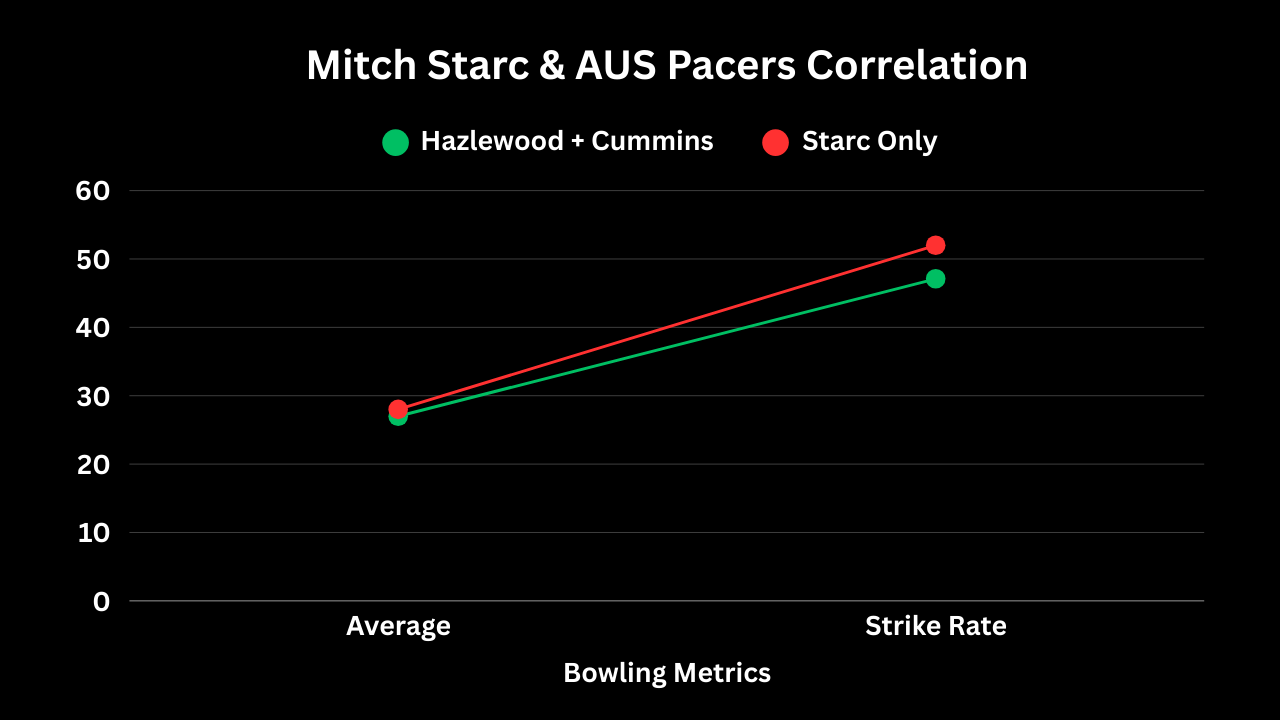
If anything, Starc benefits from their presence. Next question? Does he do better when only one of them does not play? Nope.
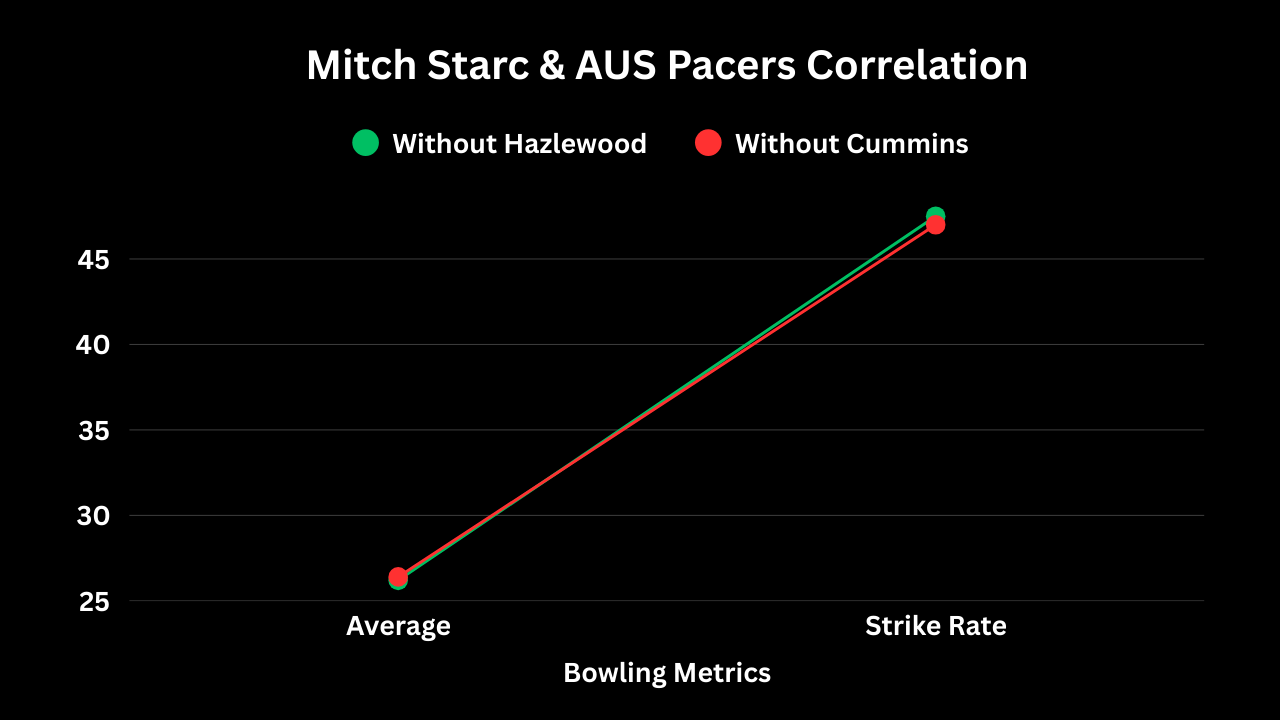
There’s literally no difference. So that rules out a case of Starc actually being overshadowed by the other two. The trio live in harmony.
Batting In Australia
But let’s look beyond Starc for a moment. We tend to forget or bring into the conversation the very commonly agreed upon opinion that the last few years have been difficult to bat in. Steve Smith even recently spoke about how Australia, over the last couple of seasons, has been as tough as it gets for batters.
Case in point – batting averages since the 2000s in Australia in Tests:
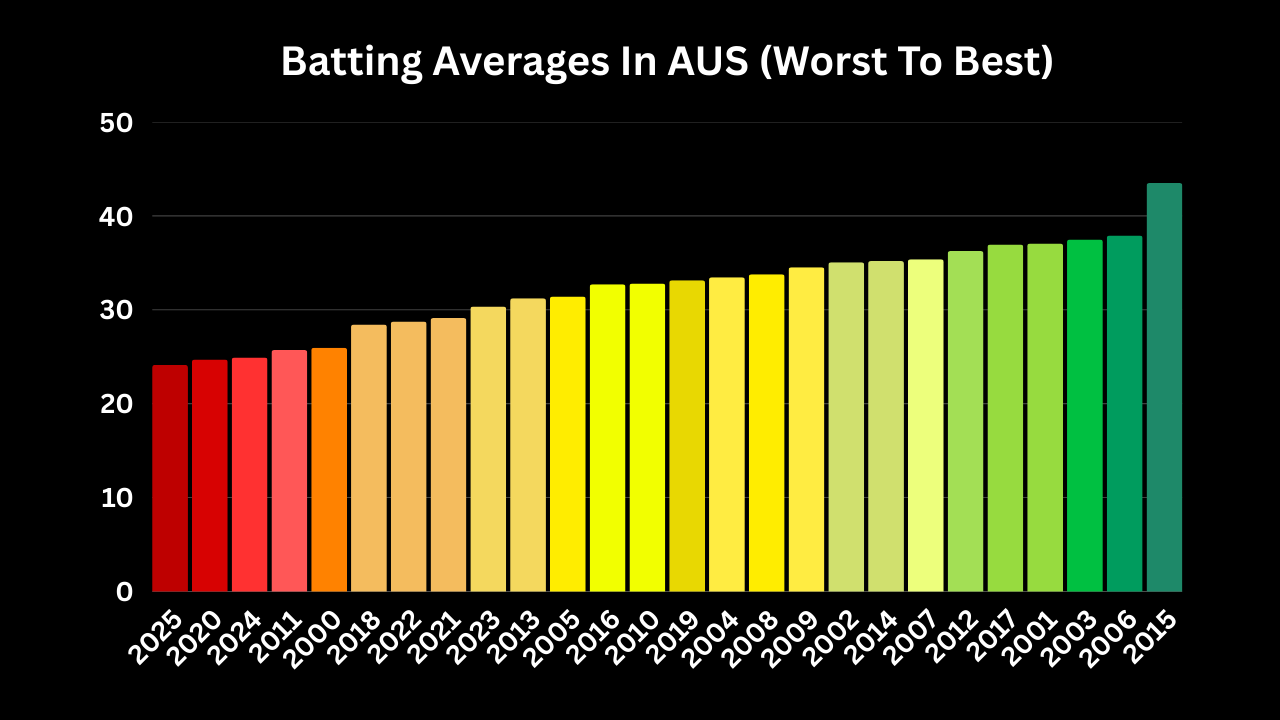
I wish I had ball-tracking data access to understand the difference in terms of seam & swing movement, and if the bowlers also have a lot more help. But outside of that, from a batting POV, 2024 & 2025 are right up there as the toughest batting years in Australia in the last quarter of a century.
Now this is important because since 2022, Starc’s played half his games at home. His returns are incredible, with 73 wickets in 16 games at 22.6, striking at 39.9.
So clearly, he’s also made merry from all the aid that pacers have been getting from the pitches in Australia.
Readers may also like: Spin Kills, Where’s The Thrill?
Longevity
Is that it? Is that all it is? Is Starc just good enough because the pitches have more grass and the ball nips around a lot more, and he’s good enough to exploit that? Nope. Just one more point. Starc’s still AROUND.
Touching 36, Starc’s still bowling as quick, if not quicker than pacers half his age! The man still runs in, hits 140 clicks and swings it big. In fact, it only seems to me that he’s gotten fitter & stronger.
He recently played his 100th Test, becoming the only other Australian pacer apart from the great Glenn McGrath to play a century of Tests. That speaks volumes. A testimony to his willingness to fall, get up, put in the yards all over and keep honing his skill.
And so that’s possibly it. Starc’s legacy isn’t in a eureka moment that transformed his game overnight.
It’s more like a wine that’s aged well, with a plethora of factors converging at the right moment. It’s a bit like an old Maruti 800 that you’ll see on a random holiday in the hills; well-maintained and beautifully driven uphill, performing much better than a new Thar.