
Gujarat Giants held their nerve as Delhi Capitals ended a topsy-turvy chase on the losing side yet again.
Despite batting brilliance from Lizelle Lee & especially Laura Wolvaardt, the Capitals found themselves falling 5 runs short in what would have been the most successful chase in WPL history.
Read our analyses below!
💥 How the Capitals handed the powerplay & game to the Giants on a platter
Eighty runs in the powerplay. Gujarat Giants’ best-ever start and the second-highest in WPL history.
It was over the moment Sophie Devine took Sneh Rana apart in the final over of the powerplay, smashing 32 runs—the most expensive over in WPL history.

But more than just freakish batting, the Delhi Capitals fumbled it from the very beginning.
Marizanne Kapp is one of the best in the business. In T20 powerplays since 2023, she’s gone at just 5.4 runs per over while being the highest wicket-taker in the world in that phase. One of the first things that went right for Gujarat Giants was negotiating Kapp safely. Despite bowling good areas and creating chances, they played her out at just over run-a-ball, milking 19 runs off her three overs.
But where Kapp was secure, and the Giants were circumspect, the fact that the remaining three overs went for 61 runs was where the game truly turned on its head.
Sophie Devine is an experienced campaigner. She’s explosive, can play long innings, and has proven it in the WPL before. Against seamers in the powerplay, if you give her any width or bowl on the stumps, she will dispatch you. Barring deliveries targeted at her body, she strikes at 130-plus everywhere else. Give her room on the offside, and that number jumps to nearly 150 as she frees her arms.
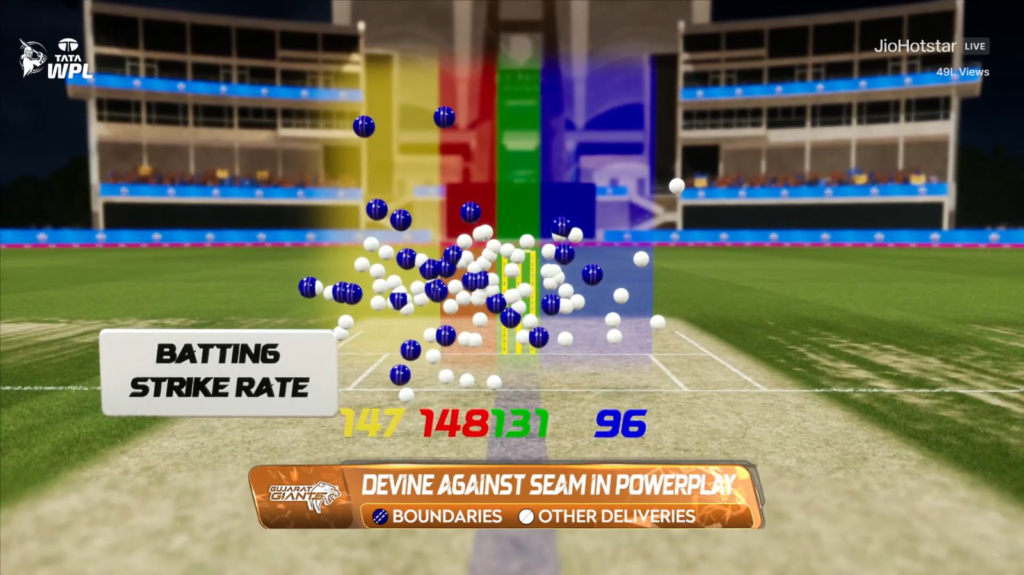
Even in terms of length, only good-length deliveries can curb Devine’s hitting prowess. Off full-length balls, she averages over 50, whereas that comes down to around 15 on the good length.
When you consider that Kapp bowled 56% of her deliveries on that good length, it makes sense why Devine couldn’t take her apart, eventually managing just 5 runs off 9 balls against her.
And that’s where the others came in—and failed spectacularly.
Chinelle Henry and Nandani Sharma started poorly against Devine. Henry got dispatched for two boundaries off full deliveries swinging away, with Devine throwing the kitchen sink at them.
Nandani bowled slightly better lines and on a good length, but mediocre fielding meant she got smashed for a couple of fours. She then overcorrected, bowling in the slot, and got tonked for a six.
A small but important tactical misstep stood out here. Kapp, who’d just finished her second over, was fielding at deep extra cover—a position that requires constant running and is a fielding hotspot. Surely you don’t want your premium fast bowler stationed in high-intensity fielding spots when they are in the middle of their spell.
The general tempo favouring Gujarat also meant that Delhi saw a missed run-out opportunity of Beth Mooney, who, until then, had played smartly to keep returning the strike to Devine.
But the final nail in the coffin was the introduction of Sneh Rana in the last over of the powerplay—against Sophie Devine.
For starters, Devine loves facing off-break. It’s her most successful matchup in terms of ball-striking—she strikes at 158 against off-spin in all T20s since 2023. To further pile on the favorability of that matchup, here’s everything else that went sideways:
- Rana isn’t the best T20 bowler going around. With an economy of 8.3 since 2023, she was already one of the more vulnerable options, especially against a set Devine.
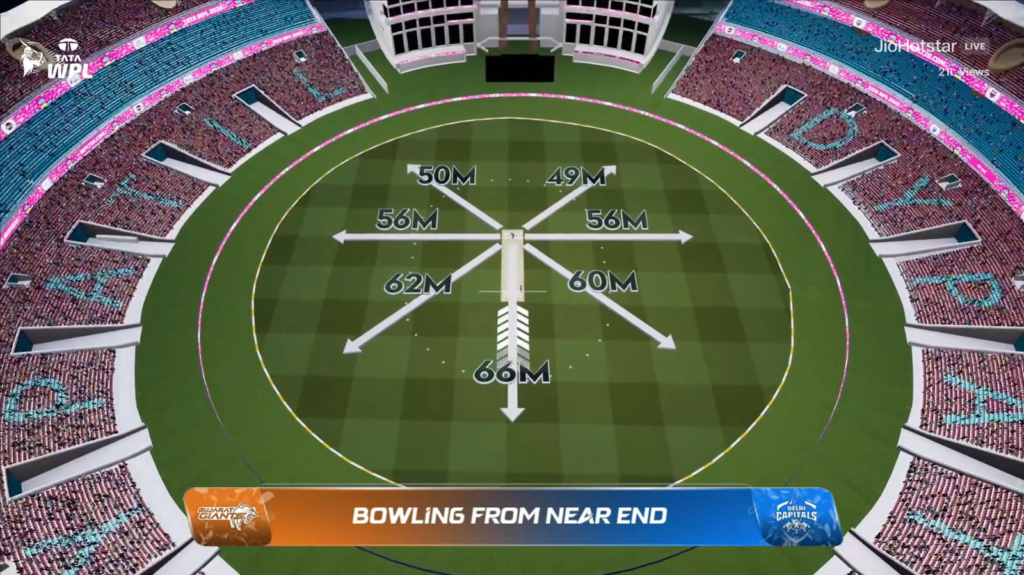
- The centre pitch was being used today. The square dimensions were a mere 56 meters, with the straight hit around 66 meters. Boundary-hitting for someone with Devine’s power was always going to be easier here.
On top of that, Rana executed poorly. Devine’s favourite hitting zone against spin is around mid-wicket. Looking at her heat map and an ideal field setting, the plan should have been clear: bowl as straight as possible, maybe even slightly outside off, with Rana’s ability to fire in a quicker yorker-type delivery. Position two deep leg-side fielders for the slog.
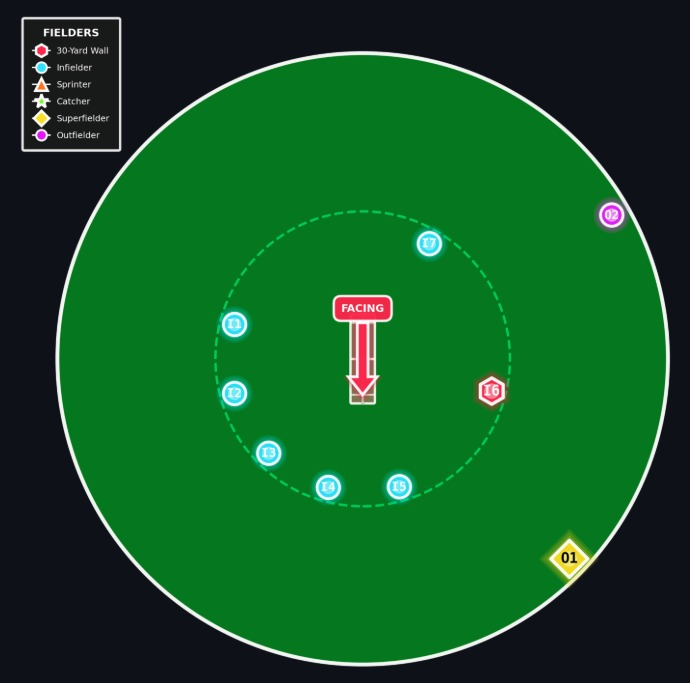
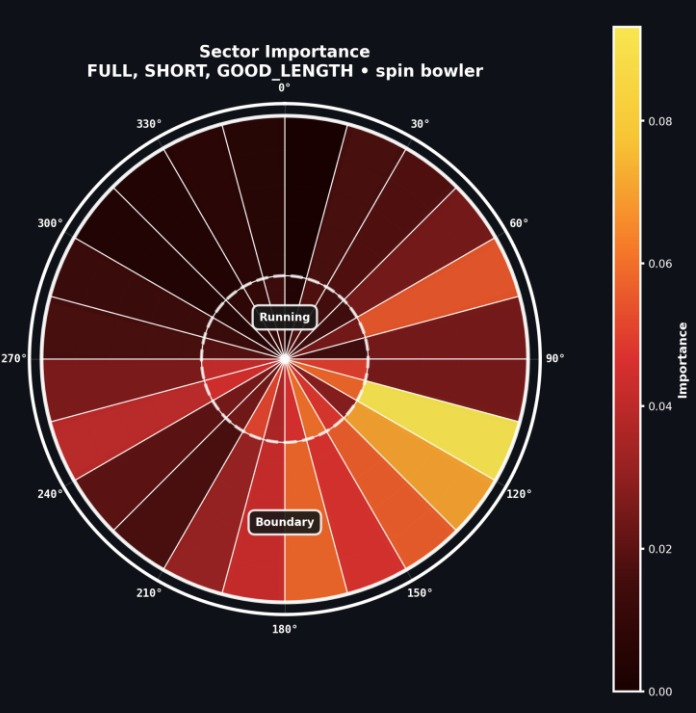
Except Rana completely missed her lines and lengths. The pitch map shows how she strayed from her line and bowled way too full, letting Devine free her arms and slog to her favourite region and a shorter boundary.
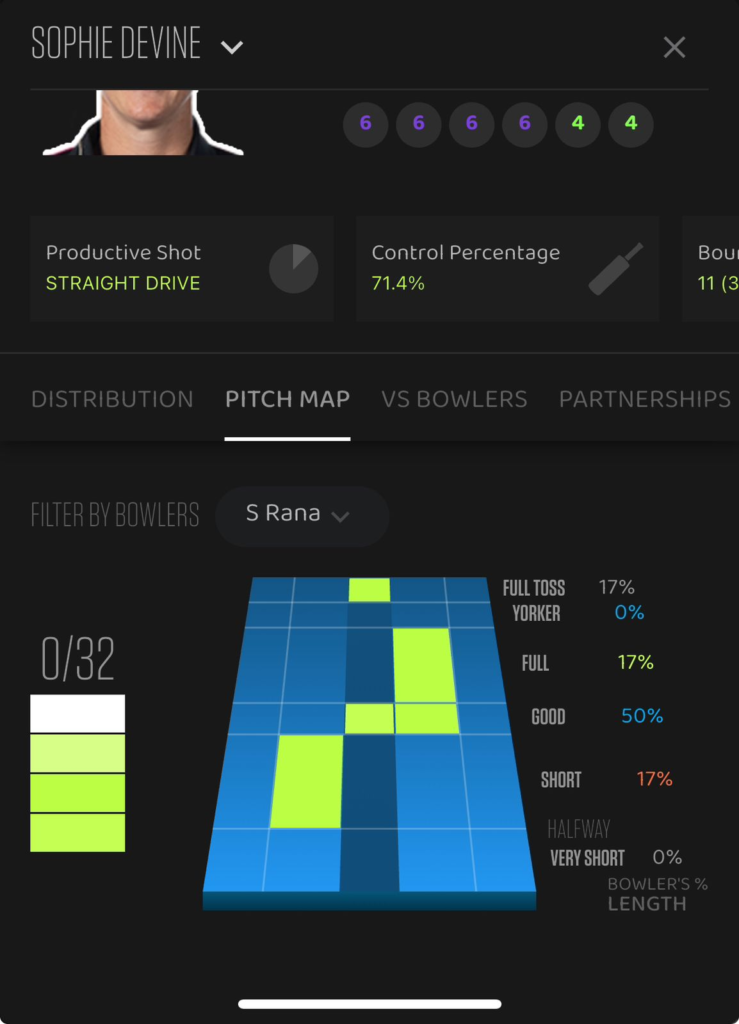
And this is what cost Delhi Capitals the powerplay—and ultimately, the game.
👀 Nandani Sharma has a fast bowler’s heart
I’d be lying if I said that I followed her bowling too closely in that first game, but a moment stood out today that made me want to observe Nandani Sharma’s bowling.
It was in the midst of her spell when she was bowling to Sophie Devine. Sharma’s start was not optimal, as Devine took her apart, owing to a couple of not-so-good fielding efforts and then an overcorrection that went for six.
She ended her first over, having gone for 16 runs. But even then, it wasn’t that she bowled poorly or her missed her cues. In fact, she even attempted a slower ball bouncer in that very over against Devine.
Come the next over, however, and Nandani unleashed an interesting bag of tricks, banging in a good, hostile bouncer against Devine before resorting to a back-of-the-hand slower one the next delivery. It was at that moment that you could see her intent in thinking and attempting different variations to keep a smashing Devine from getting to her century.
It also worked as Nandani got Devine for 95, and ended that over, giving away just 7 runs.
Across her last 2 overs was the icing on the cake, as Nandani gave away just 10 runs, picking up 4 more wickets and a hat-trick to close out the innings. Figures of 5 for 33 in only her second game, becoming the first uncapped player to take a 5fer!
She mixed her variations up well but also bowled good areas, with a majority of her deliveries being of good length or the odd quick or slow bouncer with a good line.
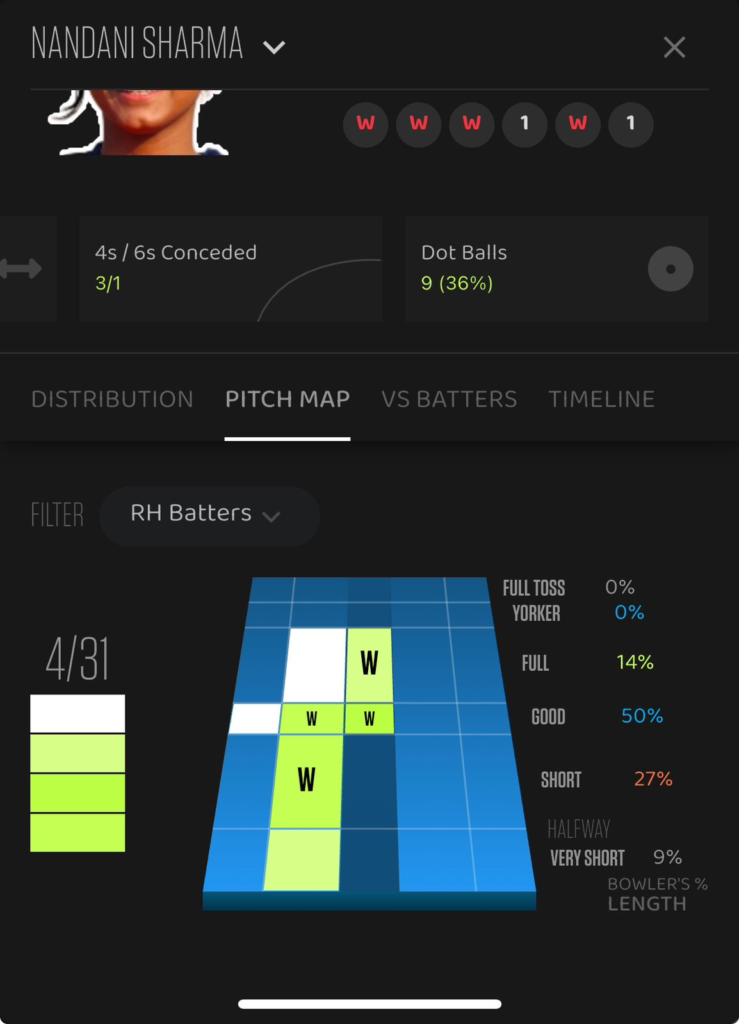
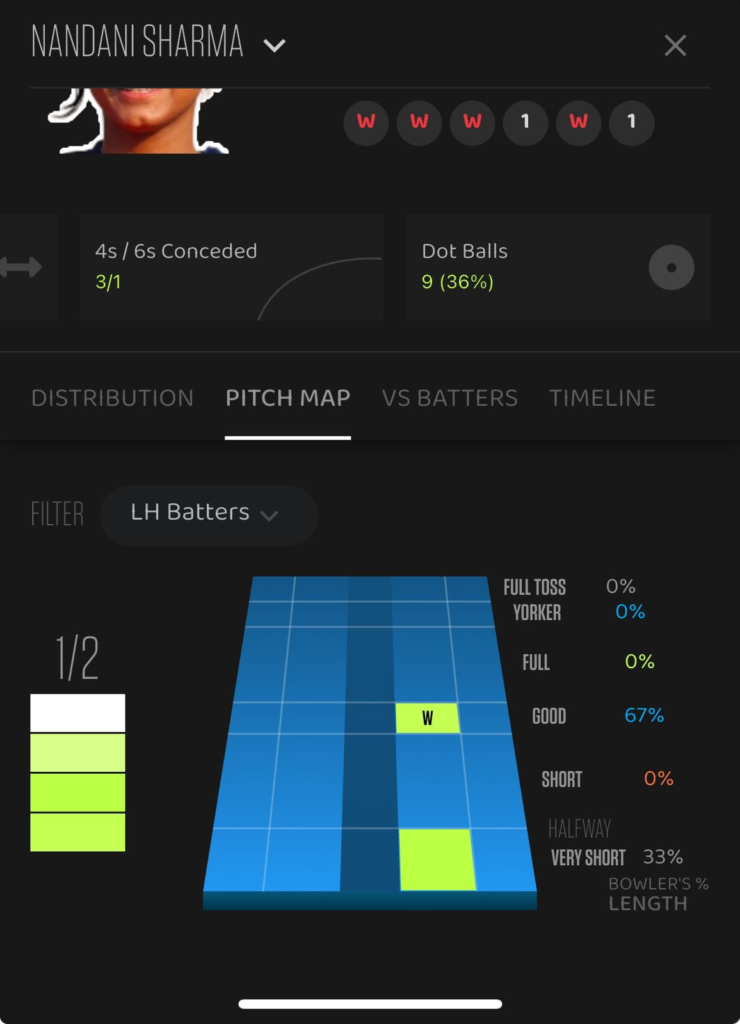
But more than just her wickets, it was the simple fact that she was the only bowler in the innings apart from Kapp to not go at over 10 runs per over.
In just 2 games, Nandani Sharma has raised her hand twice. What will be important for DC, especially given their powerplay mishaps, is to handle Sharma well and enable her to be the solid wicket taker she’s proved to be thus far.
I’d totally do a piece on the brilliance of Laura Wolvaardt, but I’m a little cooked so that will have to wait for another time. Regardless, this almost second coming of Wolvaardt in the WPL and her incredible acceleration game is something we were hoping to see, and it’s finally here.
With Lizelle Lee doing what she did and Wolvaardt continuing her rich form, Delhi needs their Indian batting contingent to step up, and they’ll be more than formidable.
Data from Women’s T20 Batting App using Himanish Ganjoo’s T20 cricket BBB database up until October 2025, Arnav Jain’s fielding toolkit, Cricmetric, Cricket By JB’s WPL analyses & the Broadcast.
Want to learn more about WPL stars, their numbers and what they’re good at? Try out our WPL Quiz game 🔽
Inspired by writers on Substack and the Best Cricket Stories.