
Cricket’s Net Run Rate (NRR) system has long frustrated fans and teams alike with its harsh mathematics and seemingly unfair outcomes. But in 2025, the Karnataka State Cricket Association (KSCA) took a bold step by implementing an Indian alternative in their Maharani and Maharaja Cup tournaments. This new method, called NRRR or net relative run rate, has generated significant interest across Indian cricket circles after demonstrating fairer outcomes and more competitive tournaments.

The successful trial in Karnataka’s premier domestic competitions has sparked conversations about whether this innovation could replace the NRR system that has governed cricket rankings for decades. The results from these tournaments show promise for a more balanced approach that considers wickets alongside runs and overs.
The Problem with Current NRR
The existing NRR method creates scenarios where teams face insurmountable deficits after just one close loss. Consider this example that perfectly illustrates the issue:
Scenario: In a T20 match, Team A gets all out for 80 runs. Team B wins by scoring 81/9 in just 10 overs.
NRR Results:
- Team A: -4.10
- Team B: +4.10
Despite this being a marginal victory (Team B nearly collapsed chasing a low target), the NRR suggests a dominant performance. For Team A to recover from this -8.2 combined deficit in future matches, they would need to win by 200+ runs – an almost impossible task in T20 cricket.
How NRRR or Net Relative Run Rate Works
NRRR or net relative run rate addresses this flaw by incorporating wickets lost alongside runs and overs. The method uses par-score tables (similar to those used in DLS calculations) to determine what score was realistically expected given the resources available.
The NRRR Formula
The NRRR or net relative run rate calculation considers:
- Runs scored by both teams
- Overs played
- Wickets lost (the crucial missing element in NRR)
- Par scores based on resources available (taken from the DLS method)
Formula: RRR for Team-1 = (Score of Team1/100) × [1 – (Score of Team2/Par-score Team2)]
The Same Example with NRRR
Using the same T20 scenario where Team A gets all out for 80 runs & Team B scored 81/9 in 10 overs:
NRRR Results:
Now we apply the above mentioned formula to calculate RRR & NRRR.
RRR for Team-1 = (80/100) x [ 1 – (81/73) ]
Therefore, RRR for Team-1 = 0.8 x [ 1 – 1.11 ] = 0.8 x (-0.11) = -0.088
The NRRR or net relative run rate method hence shows a combined deficit of just 0.176, which Team A can overcome with a victory margin of 17+ runs – a realistic and achievable target.
Why the Dramatic Difference?
The key lies in the par-score calculation. When Team B reached 81/9 in 10 overs, the par-score (expected score for that situation) was 73 runs. Therefore, Team B only exceeded expectations by 8 runs, not the massive margin suggested by traditional NRR.
Real-World Application: KSCA Tournaments
The NRRR or net relative run rate method isn’t just theoretical. The Karnataka State Cricket Association (KSCA) successfully implemented it in their 2025 Maharani and Maharaja Cup tournaments, providing valuable real-world data on its effectiveness.
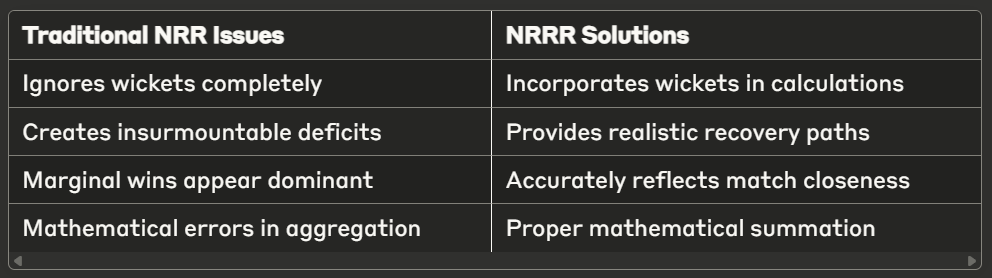
Here’s a table as well to summarise some key differences between the two methods:
Key Advantages of NRRR
1. Fairer Assessment of Victory Margins
NRRR or net relative run rate accurately reflects how convincing a victory actually was, considering both runs scored and wickets lost.
2. Realistic Recovery Opportunities
Teams aren’t eliminated from contention after one close loss, maintaining tournament competitiveness.
3. Wickets Matter
The method acknowledges that losing 9 wickets while chasing is fundamentally different from winning easily with wickets in hand.
4. Mathematically Sound
Unlike NRR’s flawed aggregation method, NRRR or net relative run rate uses proper mathematical summation of individual match values.
Also check out out conversation with V Jayadevan of the VJD method:
The Road to Implementation
The research paper by Keshav S Kolle and Jayadevan V demonstrates that NRRR or net relative run rate provides “extremely logical results” when applied to tournament scenarios. The method has been tested on IPL 2024 data, showing consistent improvements over traditional NRR outcomes.
BCCI’s Potential Interest
Given that the BCCI previously introduced the VJD method (an alternative to DLS) in 2007 for domestic cricket, there’s precedent for Indian cricket authorities exploring innovative solutions. The successful implementation in KSCA tournaments provides valuable feedback for potential broader adoption.
Readers may also like: How Jayadevan’s Passion Brought VJD method to life!
Why Change Matters
Cricket’s growth depends partly on fair and understandable systems that maintain competitive balance. NRRR or net relative run rate offers several benefits:
- Fan Engagement: More teams remain in contention longer
- Competitive Balance: Close matches don’t eliminate teams unfairly
- Accurate Representation: Results reflect actual match dynamics
- Tournament Integrity: Every match matters throughout the competition
Implementation Challenges
While NRRR or net relative run rate offers clear advantages, implementation requires:
- Par-score Tables: Available from existing DLS/VJD systems
- Calculation Tools: Simple worksheets can handle computations
- Stakeholder Education: Teams and officials need to understand the system
- ICC Approval: International implementation requires governing body acceptance
The Future of Cricket Ratings
The NRRR or net relative run rate method represents more than just a mathematical improvement – it’s a step toward fairer, more engaging cricket tournaments. As the sport continues evolving, systems that accurately reflect performance while maintaining competitive balance become increasingly important.
The research demonstrates that change is not only possible but beneficial. With successful real-world implementation in KSCA tournaments and compelling mathematical arguments, NRRR or net relative run rate presents a viable path forward for cricket’s ranking systems.
Whether international cricket authorities will embrace this innovation remains to be seen, but the evidence strongly suggests that there is scope to keep your eyes open to constant innovations within the sport.











A good method. I have 2 questions for now though..
1. If resources are to be valued, how do we grade them. It is common knowledge that a No. 1 or 3 batter is not the same a No. 9, 10 or 11 batter when it comes to run scoring. why is this ignored?
2. If resource control is primary, then should this concept directly appear in the points awarded? That seems binary. Sport is many time ‘take is all’ game. Calcs should be simple, not mathematically complex. Is this taking that elegance away?
3. Resource conventionally planned based on challenge. A team could try a new concept in a scenario where they are chasing a low score, this approach restrains them.
Can this be more refined?
It also appears in a group competition, head to head matches has disproportionate impact on the final NRRR.
Once the head to head match with the closest competition is won comfortably, the other matches have way less impact.
Is this by design or unintended consequence?
It also appears this RRR is extremely sensitive to wickets lost.
Just my thoughts